
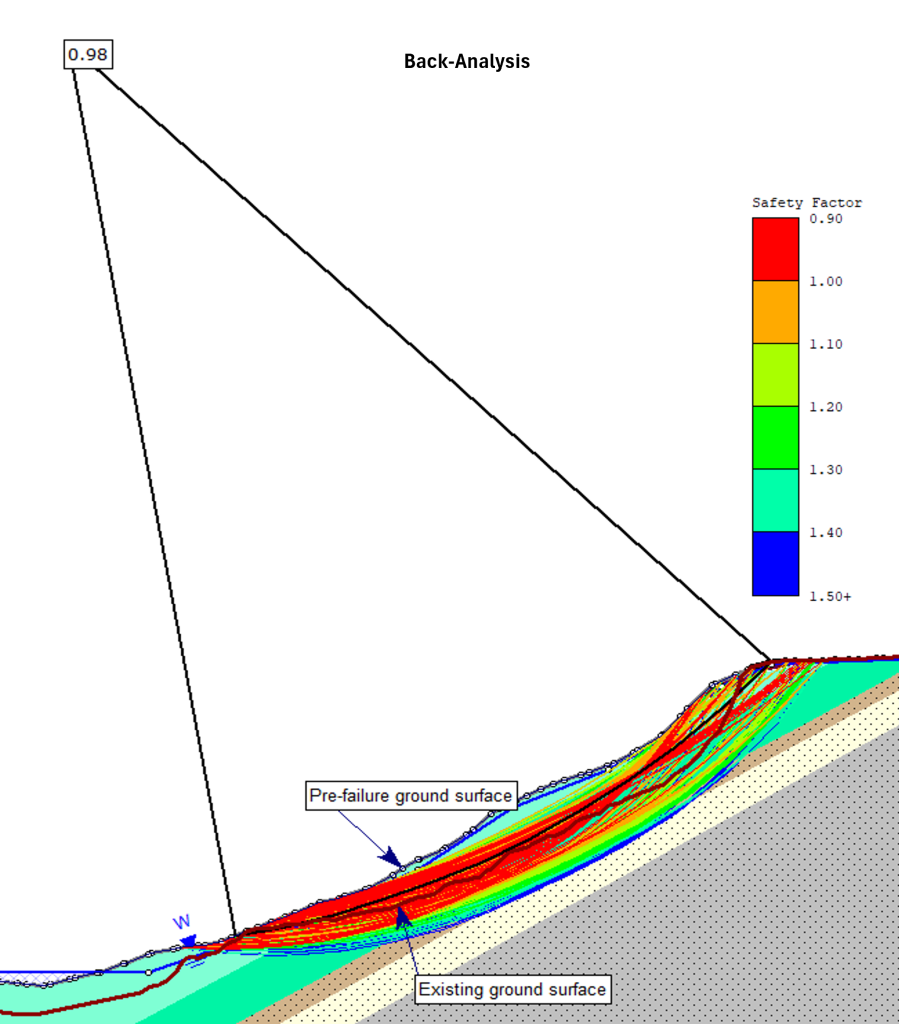
Unit 3 builds on the guidance in Part 7 of Unit 1 and centres on assessing landslide triggers in soil and rock slopes using limit equilibrium methods (LEM). These methods are commonly used in New Zealand and worldwide for routine projects because they provide reliable stability assessments. Their effectiveness is proven by analysing actual cases and practical applications.
Unit 3 gives an overview of key topics like rock and soil mechanics, types of LEM, and the mechanics of these procedures. While these are covered in detail in other texts, this document focuses on practical LEM applications, especially in challenging scenarios or common misunderstandings in analysis. The main topics include:
- Rock strength and stability assessment
- Estimating soil strength
- Partial saturation, modelling pore pressure distributions, and high rainfall scenarios
- Selecting target Factor of Safety (FoS) considering uncertainty and consequences
- Seismic slope stability analysis and deformations
- Handling uncertainty
Drawing on the prior work of Silva et al, Unit 3 provides a mathematically derived basis for Factor of Safety selection under Long-term Static conditions and High Ground Water conditions.
Comments on the draft of Unit 3 should be addressed to the NZGS secretary (secretary@nzgs.org) and should be forwarded no later than Friday 6 June 2025. PDF Markups are preferred where this is possible.
Thank you to the authorship team of Alan Wightman, Naomi Norris, Eleni Gkeli, Pat Shorten and Doug Mason!