

A report on the 4th European Regional Conference of the IAEG
Introduction
The International Association for Engineering Geology and the Environment supports regional conferences in each of its six regions (Europe, Australasia, Africa, North America, Latin America and Asia).
The most recent of these was the 4th European Regional Conference of the IAEG, hosted in Dubrovnik by the IAEG National Group of Croatia. About 250 people attended from all over the world. New Zealand was well represented at the conference with attendees including Ann Williams, Ross Roberts and Martin Brook. Ann and Ross attended to participate in the IAEG Council Meeting which occurred before the main conference, which is reported in a separate article.

1. Themes and programme
The conference was broadly focused across many engineering geological disciplines ranging from site investigations and geohazard assessment to heritage protection, resource management, and artificial intelligence.
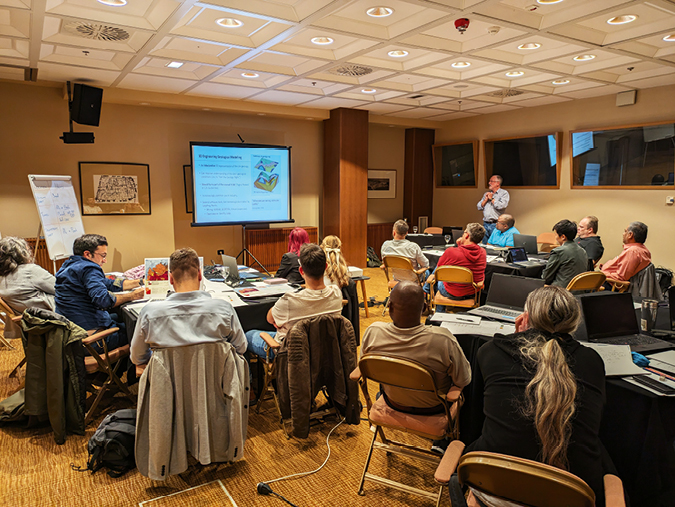
The two-day conference was preceded by a one-day meeting of the IAEG Executive Board, and a one-day meeting of the IAEG Council to vote on proposals from the Executive Board. There was also a series of training workshops delivered before and during the conference including:
• Guidelines for Engineering Geological Models (delivered by Fred Baynes and Ross Roberts)
• Preparing a manuscript for an international scientific journal: What editors and reviewers are looking for (chaired by Dr. Janusz Wasowski)
The technical content was interesting and demonstrated that practice in New Zealand, when at its best, is aligned with some of the best in the world.
A particular highlight for me was a keynote by Prof. Alexander Puzrin, who presented a delightful forensic case study of a landslide in Zurich that affected a building which, based on the entertaining description, appeared to have been occupied or owned by a whole series of eminent academics including geotechnical experts who should, perhaps, have known better. The paper is also available online (https://www.icevirtuallibrary.com/doi/epdf/10.1680/jgeot.19.P.333).
Papers from the conference were published in a hard-back proceedings, and are expected to be available in digital form online within six months.

2. Venue and entertainment
One of the most valuable parts of any conference is the opportunity to meet like-minded academics and practitioners from around the world. Dubrovnik proved to be a fantastic location for this.
Near the eastern end of the Mediterranean, Dubrovnik is easy to access from many parts of the world, which was reflected in the very diverse nature of the delegates. This was perhaps helped by the spectacular nature of the setting. Dubrovnik is on the UNESCO list of World Heritage Sites in recognition of its outstanding medieval architecture and fortified old town. Often called “The Queen of the Adriatic” Dubrovnik is considered one of the most popular destinations in Europe, and is a popular filming location (including for Game of Thrones, for which there was a surfeit of tourist shops).
The history of the city probably dates back to the 7th century, but the basic city plan dates from 1292, when the port was rebuilt following a fire. The entire city was almost destroyed in a devastating earthquake in 1667. Rebuilt as a medieval fortress, Dubrovnik has always been an important port and trading centre for the region.
The city walls, mostly a double line, have long been a source of pride for Dubrovnik. The walls were erected by the 16th century and are nearly 2km in length, encircling most of the old city, and reach a maximum height of about 25 metres. Along its course and within the walls lie several towers and fortresses, as well as numerous historic monuments. The Stradun, or main street, with beautiful late-Renaissance houses on each side, runs along a valley that, until 1272, was a marshy channel dividing the Latin island of Ragusa from the forest settlement of Dubrovnik. No motor vehicles are allowed inside the walls and the old city is a maze of picturesque narrow, steep and twisting streets filled with tourists and restaurants.
The conference made the most of this tourist-centric venue. Hosted in a huge coastal hotel, it was easy to socialise by the sea and make the most of the great discussions being held.
